How to Apply the FDA and EMA AI Principles to Patient Engagement
AI is already shaping small but consequential decisions across patient support programs. When should a patient receive outreach? Which channel is most likely to reach them? Does a behavior change signal a need for additional support? When should a nurse step in?
These use cases can make support more timely and relevant. They also raise practical questions about the data behind a decision, the level of oversight it requires, and how teams know the technology is working as intended.
The FDA and EMA’s 10 principles of good AI practice offer a useful foundation for evaluating those decisions. The principles were developed for AI used to generate or analyze evidence across the drug product lifecycle, not specifically as requirements for patient support programs. Still, their focus on context of use, risk, data quality, human involvement, and ongoing monitoring translates directly to many of the decisions patient support teams are making today.
Five Decisions for AI in Patient Support
The FDA and EMA principles span the development and use of AI. Within a patient support program, they can be distilled into five decisions that help move the conversation from principles to practice.
1. Start With the Use Case
Where AI sits in the patient support workflow changes the stakes.
Automating the delivery window for a message isn't the same as letting an algorithm decide who gets a nurse call. That distinction matters because AI doesn’t carry one universal level of risk. The underlying technology may be similar. The consequence of getting the decision wrong is not.
The level of scrutiny should follow the use case. A missed opportunity to engage is very different from a decision that could delay needed support.
Not Every AI Use Case Carries the Same Risk
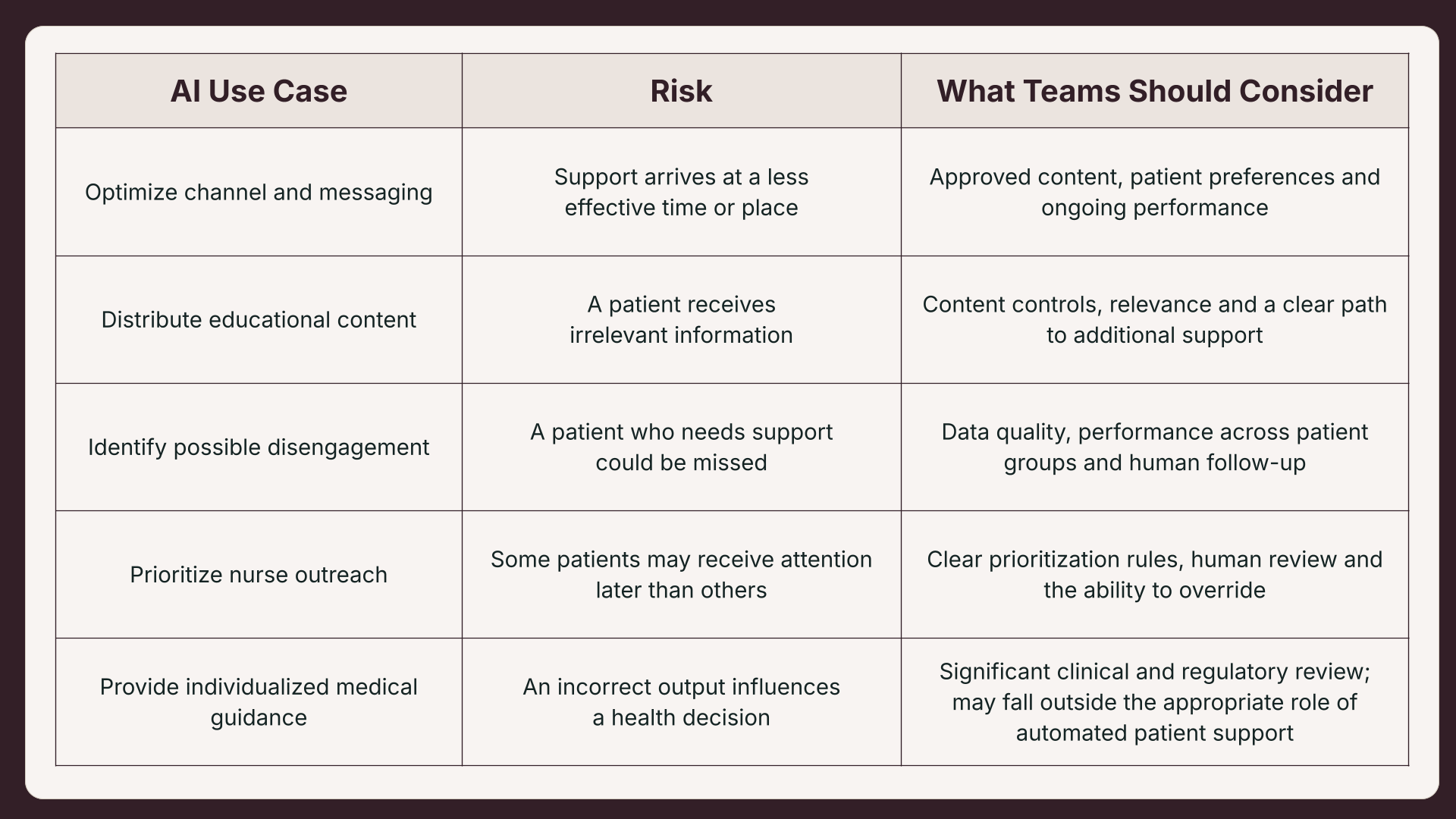
The takeaway: Don’t assign a single risk level to “AI.” Evaluate the decision it influences and what happens downstream.
Consider channel selection. One Medisafe-supported patient program found a 4.7x difference in conversion between SMS and email, alongside fewer nurse outreach attempts to confirm refills. The results show how the right engagement channel can affect both patient response and the amount of manual outreach required.
2. Know What Your Data Can Support
Before asking what AI can do with your data, ask whether your data carries enough context to drive accurate decisions.
Volume alone is misleading. A missed dose, an unanswered message, or a delayed refill rarely tells the whole story. The same signal can mean something different depending on the patient, condition, treatment, or point in the therapy journey. Understanding the reasons patients miss doses provides important context for determining which signals matter and how they should inform support.
Without rich, contextual data, AI models risk making broad assumptions that misinterpret patient intent. Building responsible AI requires moving beyond basic engagement metrics and leveraging deep, longitudinal behavioral evidence that reflects what patients are actually doing in the real world.
Medisafe has more than a decade of adherence data across therapies and patient populations. That history shows how the same behavioral signal can mean something different depending on the condition, treatment, geography, or point in therapy.
3. Decide Where People Need to Stay Involved
Every AI-enabled decision requires a clear downstream workflow.
Identifying a patient at risk of disengagement is only as useful as the program’s ability to act on that signal. While routine nudges can trigger automated digital outreach, complex needs demand review, escalation, or direct intervention from care teams. Designing these explicit handoff points ensures technology handles low-friction touchpoints while preserving human expertise for the moments that require clinical judgment and empathy.
What AI Can Look Like in a Patient Support Workflow
%20(1).png)
The same controls have to carry through the workflow. That includes how patient data is handled, who can act on an AI-generated recommendation, and when a decision needs to be reviewed. New patient responses also become part of the data available for future engagement.
Mapping these touchpoints end-to-end allows pharma teams to reduce operational friction without removing human support. It clarifies exactly where digital engagement can streamline routine tasks and where human intervention actively drives clinical value. Centering the program around real-world patient behavior keeps care teams focused on high-value interventions rather than administrative overhead.
4. Measure What Happens Beyond the Model
Technical performance is a vanity metric if it doesn't change patient behavior.
An AI model can meet every precision target and still fail to improve a support program. The more useful test is what happened after the interaction. Did the patient engage? Did it change what the support team needed to do?
Success metrics must tie back to operational and health outcomes, not algorithm stats. Response rates provide an early signal, but they aren't the final destination. That is why Medisafe evaluates outreach against long-term persistence, drawing on research with IQVIA to show the clear link between digital engagement and therapy persistence over 12 months.
5. Keep Evaluating After Launch
AI performance can shift after launch as the program and the patients it serves change.
Monitoring needs to account for that. Teams should define what they’ll watch, how often they’ll review performance, and what changes warrant a closer look.
The same applies to transparency. Patients and care teams deserve straightforward, accessible information about where AI is used. This is why the FDA and EMA frameworks emphasize lifecycle management: launch is simply the start of a program, not the finish line.
Five Questions to Ask an AI Technology Partner
The same framework can help pharma teams evaluate potential partners. Rather than starting with the sophistication of the technology, start with how it will operate inside the program.
Four questions can help teams understand how a potential technology partner would actually operate within the program.
%20(1).png)
Bringing AI Into Patient Support With Purpose
AI will likely take on a larger role in patient support. That doesn't mean every interaction needs it.
Some of the strongest use cases are relatively narrow. They help teams recognize a behavior change, choose a better time or channel for outreach, or identify when a patient may need more support. The FDA and EMA principles give pharma teams a way to evaluate those uses without treating every application of AI the same.
This is also where Medisafe's experience matters. Years of adherence and engagement data give us a view into how patient behavior changes across therapies and over time. That context can help determine where AI is useful, where a person still needs to make the call, and whether the resulting engagement is actually helping patients stay on therapy.
AI doesn't need to run the patient support program to make it better. It needs to be useful in the moments where technology can help the program respond better.