AI-Generated Messages for Medication Adherence: What 7,520 Ratings Reveal
Patient-support teams spend considerable time refining message type and tone, but new research suggests relevance depends on something more fundamental. The focus should be on identifying why a patient is struggling and delivering a message designed to address that specific barrier.
A 2026 study published in the Journal of Medical Internet Research examined 83 SMS messages designed to support antidepressant adherence. Researchers recruited 181 adults currently prescribed an antidepressant and collected 7,520 ratings of how helpful the messages might be in remembering to take medication.
AI-generated messages received significantly higher perceived-helpfulness ratings than messages written by the study team. The takeaway isn’t that AI writes better copy. The point is that relevant messaging begins before the writing starts.
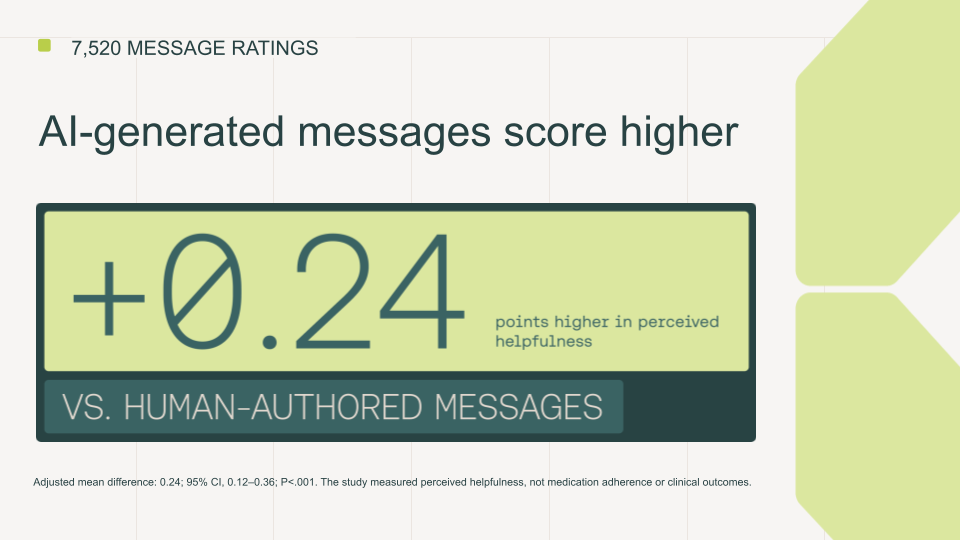
What Patients Found More Helpful
The study began by identifying four adherence barriers:
- social stigma
- uncertainty about the need to continue medication
- delayed symptom benefit
- forgetfulness or lack of routine
Researchers used established behavior-change techniques and a framework for identifying what must change for a behavior to occur to connect each adherence barrier with an appropriate intervention strategy.
That structure matters because medication nonadherence rarely has a single cause. A reminder may help when a patient forgets a dose, but it will not address doubts about continuing a treatment when the benefits aren’t apparent.
Messages addressing delayed symptom benefit received higher ratings than those focused on the other barriers evaluated. Messages emphasizing self-monitoring, habit formation, and natural consequences also received higher ratings than messages relying on external influence or support. Researchers found no meaningful difference between motivational and informational messages.
For patient-support teams, the takeaway is clear: message relevance depends on the patient’s barrier and where they are in treatment, not tone alone.
A Four-Step Process for More Relevant Patient Messaging
The findings point to a practical process for developing patient communication:
.png)
AI can accelerate the third step by generating multiple message variations from a defined barrier, behavioral strategy, and set of approved examples. That is how it was used in the study: researchers supplied specific instructions and human-written examples, then reviewed every message for accuracy, clarity, and alignment.
AI did not replace the behavioral framework, patient input, or human oversight. It made it faster to develop and evaluate more options. Patient-support teams still need a responsible framework for using AI in patient support.
From More Messages to More Relevant Support
The study measured whether patients perceived the messages as helpful. It did not establish that AI-generated messages improved medication adherence or clinical outcomes.
Helpfulness ratings can inform early message development, but patient-support teams must still measure what happens after deployment: whether patients receive and understand the message, whether it prompts an appropriate response, and whether engagement contributes to adherence and persistence over time.
The opportunity is to build a support system that recognizes changing patient patterns and delivers the right message through their preferred communication channel at the right moment. AI helps scale that approach, while behavioral intelligence and patient input keep the experience relevant.